
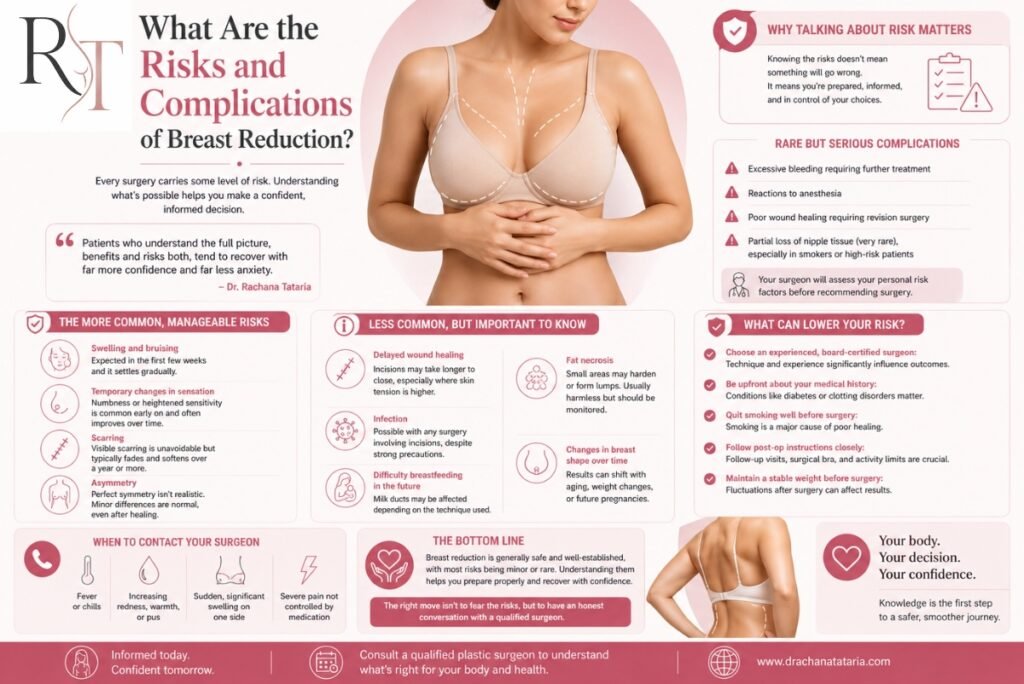
What Are the Risks and Complications of Breast Reduction?
If you’re considering Breast Reduction Surgery, you’ve probably already heard about the benefits: less back pain, better posture, more comfort in daily life. But there’s another side to the conversation that deserves just as much attention: the risks.
This isn’t about scaring you away from the procedure. It’s about walking in with clear eyes, so you can make a decision you feel genuinely confident about.
Why Talking About Risk Actually Matters
Every surgery carries some level of risk; that’s simply a fact of medicine, not a red flag specific to this procedure. The goal here is to help you understand what’s possible, what’s common, and what’s rare, so nothing catches you off guard.
Dr. Rachana Tataria, who has performed breast reduction procedures for years, puts it simply: “Patients who understand the full picture, benefits and risks both, tend to recover with far more confidence and far less anxiety.”
The More Common, Manageable Risks
These are the ones most patients may experience in some mild form, and they’re usually temporary.
- Swelling and bruising: Expected in the first few weeks, and it settles gradually.
- Temporary changes in nipple or breast sensation: Numbness or heightened sensitivity is common early on and often improves over several months.
- Scarring: Since incisions are necessary, some visible scarring is unavoidable. It typically fades and softens over a year or more.
- Asymmetry: Perfect symmetry isn’t realistic for any body, and very minor differences between the two breasts are normal, even after healing.
Less Common, But Important to Know
These happen less frequently, but they’re worth understanding so you know what to watch for:
- Delayed wound healing: Incisions may take longer to close properly, especially at points where skin tension is higher.
- Infection: Though surgical teams take strong precautions, infection remains a possibility with any procedure that involves incisions.
- Difficulty breastfeeding in the future: Depending on the surgical technique used, milk ducts may be affected, which is an important conversation to have if you’re planning to breastfeed later.
- Fat necrosis: Occasionally, small areas of fatty tissue don’t get enough blood supply and harden or form lumps. It’s usually harmless but should be monitored.
- Changes in breast shape over time: As with most breast surgeries, results can shift somewhat with aging, weight changes, or future pregnancies.
Rare but Serious Complications
These are uncommon, but they’re part of a transparent conversation:
- Excessive bleeding requiring further treatment
- Reactions to anesthesia
- Poor wound healing requiring revision surgery
- Partial loss of nipple tissue in rare cases, especially in patients with certain risk factors like smoking
Your surgeon will assess your personal risk factors, including habits like smoking, existing health conditions, and the size of reduction needed before recommending the procedure.
What Can Lower Your Risk?
You have more control here than you might think.
- Choose an experienced, board-certified surgeon: Technique and experience significantly influence complication rates.
- Be upfront about your medical history: Conditions like diabetes or clotting disorders change the risk profile and the precautions needed.
- Quit smoking well before surgery: Smoking is one of the biggest contributors to poor wound healing.
- Follow post-op instructions closely: Wearing your surgical bra as advised, avoiding heavy lifting, and attending follow-up visits all matter more than people expect.
- Maintain a stable weight before surgery: Significant weight fluctuations after surgery can affect your final results.
When to Contact Your Surgeon
Don’t hesitate to reach out if you notice:
- Fever or chills
- Increasing redness, warmth, or pus at the incision site
- Sudden, significant swelling on one side
- Severe pain that isn’t controlled by prescribed medication
Catching complications early almost always makes them easier to manage.
The Bottom Line
Breast Reduction Surgery is generally considered a safe and well-established procedure, with Dr. Rachana Tataria. Like any surgery, it does carry risks, most minor, some rare, but understanding them beforehand is what allows you to prepare properly and recover with confidence.
The right move isn’t to fear the risks, but to have an honest, detailed conversation with a qualified surgeon who can walk you through how these risks apply specifically to your body and health history.