
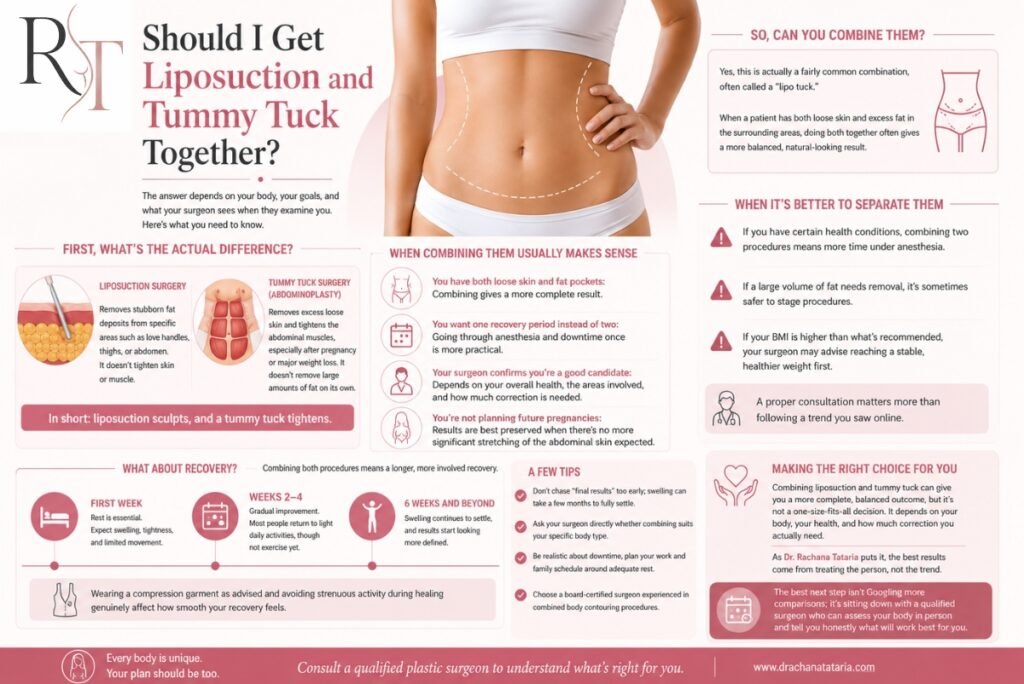
Should I Get Liposuction and Tummy Tuck Together?
If you’ve been researching body contouring, you’ve probably come across this question more than once: should you combine Liposuction Surgery and Tummy Tuck Surgery into one procedure, or keep them separate?
It’s a smart question to ask, because the answer genuinely depends on your body, your goals, and what your surgeon sees when they examine you. Let’s break it down in plain, practical terms.
First, What's the Actual Difference?
These two procedures often get lumped together, but they solve different problems.
- Liposuction Surgery removes stubborn fat deposits from specific areas, such as love handles, thighs, or abdomen. It doesn’t tighten skin or muscle.
- Tummy Tuck Surgery (technically called abdominoplasty) removes excess loose skin and tightens the abdominal muscles, especially after pregnancy or major weight loss. It doesn’t remove large amounts of fat on its own.
In short: liposuction sculpts, and a tummy tuck tightens. Many people actually need a bit of both.
So, Can You Combine Them?
Yes, this is actually a fairly common combination, often called a “lipo tuck.” Dr Rachana Tataria, who regularly performs combined body contouring procedures, explains it well: “When a patient has both loose skin and excess fat in the surrounding areas, doing both together often gives a more balanced, natural-looking result than treating just one issue alone.”
When Combining Them Usually Makes Sense
- You have both loose skin and fat pockets: If your main concern is only fat with good skin elasticity, liposuction alone might do the job. But if the skin is loose too, combining gives a more complete result.
- You want one recovery period instead of two: Going through anesthesia and downtime once, rather than twice, is a practical reason many patients prefer the combined approach.
- Your surgeon confirms you’re a good candidate: This depends on your overall health, the areas involved, and how much correction is needed.
- You’re not planning future pregnancies: Tummy tuck results are best preserved when there’s no more significant stretching of the abdominal skin expected afterward.
When It's Better to Separate Them
There are situations where doing both at once isn’t the best idea:
- If you have certain health conditions, combining two procedures means more time under anesthesia, which isn’t ideal for everyone. Your surgeon will assess this carefully.
- If a large volume of fat needs removal, sometimes it’s safer to stage procedures rather than do everything in one sitting.
- If your BMI is higher than what’s recommended, some surgeons prefer patients to reach a stable, healthier weight first for safer results.
This is exactly why a proper consultation matters more than following a trend you saw online.
What About Recovery?
This is often the deciding factor for many patients, so let’s be upfront about it.
Combining both procedures does mean a longer, more involved recovery compared to either surgery alone. Here’s a general idea:
- First week: Rest is essential. Expect swelling, tightness, and limited movement.
- Weeks 2-4: Gradual improvement. Most people return to light daily activities, though not exercise yet.
- 6 weeks and beyond: Swelling continues to settle, and results start looking more defined.
Wearing a compression garment as advised and avoiding strenuous activity during healing genuinely affect how smooth your recovery feels.
A Few Tips
- Don’t chase “final results” too early; swelling can take a few months to fully settle.
- Ask your surgeon directly whether combining suits your specific body type, rather than assuming it’s automatically better.
- Be realistic about downtime, plan your work and family schedule around adequate rest.
- Choose a board-certified surgeon experienced in combined body contouring procedures, since technique matters as much as the decision itself.
Making the Right Choice for You
Combining Liposuction Surgery and Tummy Tuck Surgery can absolutely give you a more complete, balanced outcome, but it’s not a one-size-fits-all decision. It depends on your body, your health, and how much correction you actually need.
As Dr. Rachana Tataria puts it, the best results come from treating the person, not the trend. The best next step isn’t Googling more comparisons; it’s sitting down with a qualified surgeon who can assess your body in person and tell you honestly what will work best for you.